Showing posts with label zebra mussel. Show all posts

Tuesday, November 30, 2010

Invasion causes resource switching

This article highlights some of the impacts zebra mussels have had on the Great Lakes ecosystem. The authors tested the hypothesis that feeding ecology and depth distribution of lake whitefish have changed with the establishment of dreissenid mussels in the Great Lakes.

Lake Whitefish
Contemporary samples of lake whitefish diets and catch records along with isotopic signatures of lake whitefish and benthic invertebrate tissues were contrasted with previously unreported historic data to demonstrate a greater reliance of lake whitefish on nearshore resources following dreissenid colonization.

Lake whitefish diets were stable over the available 50 year record previous to zebra mussel invasion (1947-1997). After zebra mussel establishment (2001-2005), there was a sudden change in isotopic signatures (3% enrichment in 13C and 1% in crease in 15N). The shifts in signatures coincide with shifts in mean depth of capture of lake whitefish towards the nearshore.
Fig. 4  Box and whisker plot of lake whitefish scale isotopic signatures of a δ13C b δ15N in South Bay, Lake Huron, collected from age 5 fish before dreissenid establishment (open boxes) and after establishment (2001–2005, shaded boxes).
Figure 4 illustrates how the isotopic signatures of lake whitefish have changed after zebra mussel invasion. From this figure it's easy to see the increase in δ13C over time after invasion suggesting more littoral carbon sources relative to pre-invasion samples. There is also a noticeable decline in δ15N after invasion suggesting possible restructuring of food chains or trophic levels OR a significant dietary shift in lake whitefish relative to pre-invasion lake whitefish samples.
Fig. 7 Seasonal diet composition of lake whitefish in South Bay, Lake Huron, collected in a 1947 and b 2005. Predominantly profundal prey are solid shades; predominantly littoral prey are patterned segments; pelagic prey (primarily Bythotrephes) are open segments with checkerboard pattern. Numbers above bars are percentage of fish collected with stomach contents. “Avg.” is the average diet composition over the entire year, weighted by the percentage of fish with stomach contents. Depth zone 3 is >30 m depth, as per McNickle et al. (2006).

Figure 7 has a lot of information packed into it. The main point is to focus on shifts in the dietary components pre and post zebra mussel invasion. Lake whitefish diets have gone through a complete overhaul since the invasion. You see pre-invasion diets shift from primarily diporeia, sphaeriidae and chironomids (more pelagic prey) to gastropods, dressenids and ephemeropterans (more littoral prey). This supports the isotope data compiled in Figure 4.

Dietary shifts in the lake whitefish could mean drastic changes in energy flow, potentially impacting their health and condition. This could have huge implications on the lake whitefish fishery as there may be fewer, and potentially smaller fish, thus reducing catch quotas and increasing fishing efforts.

This study was first to report changes in the carbon source available to lake whitefish associated with restructured benthic communities after the appearance of dreissenid mussels. This study contributes to a growing body of work that demonstrates the ecological insights that can be gained through isotopic analysis of archived fish bony tissues in ecosystems that have experienced significant levels of disturbance.

Reference:
Rennie, M.D., Sprules, W.G., Johnson, T.B. (2009) Resource switching in fish following a major food web disruption. Oecologia 159(4): 789-802.

Zebra mussels screw everything up

This study documented changes in the overall density and composition of benthic invertebrate communities in South Bay associated with the invasion of zebra mussels (D. polymorpha). The quagga mussel, D. bugensis, had not invaded South Bay at the time of this study.

Fig 3. Interaction of year and depth zone on log(x+1) mean density of organisms (one standard error is shown but is not visible on log scale) for various taxonomic groups. Depth zones 1, 2, and 3 correspond to shallow, intermediate and deep respectively. For clarity, depth zone values are offset for each group.
Figure 3 shows density changes in four ecologically important macroinvertebrate species in South Bay pre- and post zebra mussel invasion. Overall, you can see there is a general decline in densities over the three depth zones. The most significant decline is seen in Diporeia, which is a main dietary component of a commercially important fish, Lake Whitefish.

Fig. 5 Interaction of year and depth zone on the mean relative abundance of organisms (one standard error of the mean is shown) for various taxonomic groups. Depth zones 1, 2, and 3 correspond to shallow, intermediate and deep, respectively.


Variety of macroinvertebrates commonly
found in North American freshwater
systems.

Figure 5 perfectly illustrates the changes in relative abundance of four ecologically important macroinvertebrates in the South Bay ecosystem. Diporeia decline in the deep zones, where as oligochaeta and chironomidae appear to increase in this zone. There are drastic decreases in chironomidae in the shallow and intermediate zones and slight increases in oligochaeta in these zones. Figure 5 suggests there a potential restructuring of the benthic community resulting from the establishment of zebra mussels.

This study did a great job at illustrating changes in the benthic community, and the implications of these changes on native species, after the invasion of zebra mussels.
 
One of the limitations of this study was the lack of information necessary to make biomass estimates. Looking at biomass instead of abundance may influence the results of this study.

Reference:
McNickle, G.G., Rennie, M.D., Sprules, W.G. (2006) Changes in benthic invertebrate communities of South Bay, Lake Huron following invasion by zebra mussels (Dreissena polymorpha), and potential effects on lake whitefish (Coregonus clupeaformis) diet and growth. Journal of Great Lakes Research 32: 180-193.

Tuesday, November 23, 2010

Losing life one filter at a time

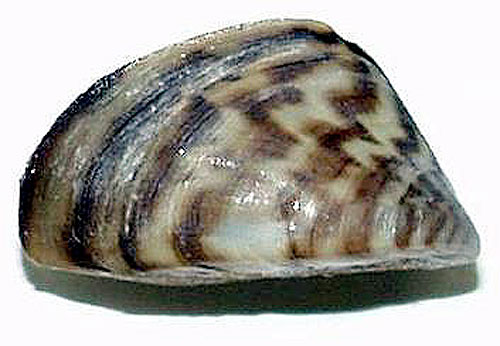
Zebra mussel showing characteristic striping.
I can't rightfully call myself an invasive species blogger if I don't discuss one of the most well known invasive in North America: the zebra mussel.

Zebra mussels are the small mussels you commonly see covering rocks and piers all over the Great Lakes. Their shells are sharp (the reason I bought good quality water shoes) and have a striped pattern, giving them their name.

They are very similar to another invasive mussel, the quagga mussel. The easiest way to tell the which mussel you're looking at is to place the mussel on a flat surface. If it stays up, you have a zebra mussel (relatively flat underside), it it falls over you have a quagga (rounded underside).

Both invasive mussels hail from the same Ponto-Caspian region of Europe (Black, Caspian and Azov seas) and their expected vector for introduction is ballast water exchange.


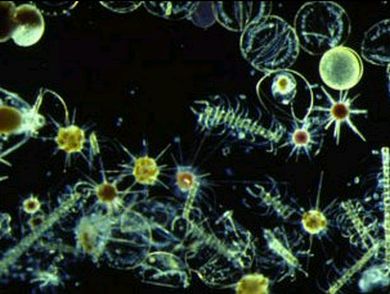
Various types of phytoplankton - food for zebra mussels.

Zebra mussels are filter feeders, primarily consuming phytoplankton. Large populations of zebra mussels in the Great Lakes and Hudson River reduced the biomass of phytoplankton significantly following invasion (Holland 1993).

Phytoplankton fuel offshore and nearshore foodwebs so a reduction in this essential organism will cause bottom-up effects in the native foodweb most likely causing a reduction in health, condition and ultimately population size of organisms in  higher trophic levels.

There are many ecological, economic and social impacts associated with zebra mussels. I've listed a few to to get an idea of their impact:

Zebra mussels encrusting a water intake pipe.

- Constriction of flow on water intake pipes, affects heat exchangers, condensers, fire fighting equipment, air conditioning and cooling systems.

- Increased drag on ship due to zebra mussel attachment (higher fuel cost, longer trip duration, etc.)
- Detrimental effects on health and condition of native fish species
- Biomagnification of Polychlorinated Biphenyls (PCBs)

For more information on this organism you can visit the following sites:
http://nas.er.usgs.gov/queries/factsheet.aspx?speciesid=5
http://www.mnr.gov.on.ca/en/Business/Biodiversity/2ColumnSubPage/STEL02_167267.html
http://seagrant.psu.edu/publications/fs/zebraquagga2007.pdf